
Author: Štefan Šurina
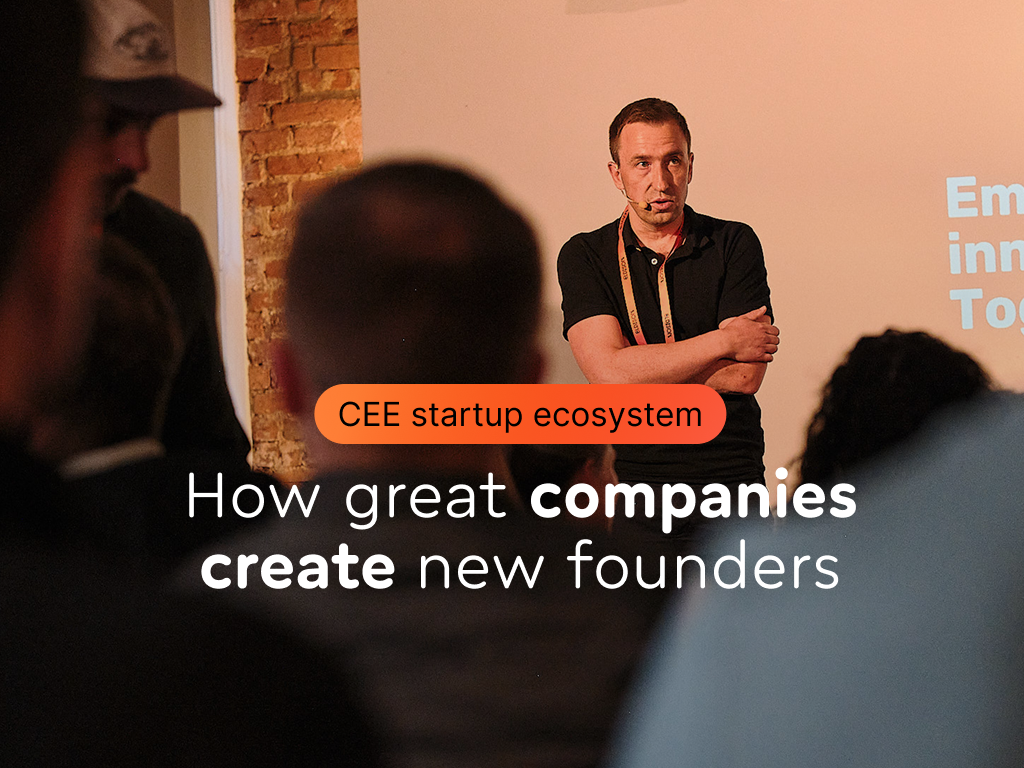
This post accompanies The Founders’ Underground: Startup Mafia, Eldison’s side event at the Engaged Investments Conference in Prague on October 21, 2026. On stage: Matthijs Welle (CEO, Mews), Uršula Králová (Chief People Officer, Bloomreach; former COO, Exponea), and Jason Smith (CEO and co-founder, TRIFFT; ex-Exponea), moderated by Štefan Šurina from Eldison.
Every startup hub has a handful of companies whose former employees end up founding, funding, and running the next wave. Silicon Valley calls this a mafia, after the roughly 220 people who worked at PayPal before its IPO and went on to start Tesla, LinkedIn, Palantir, SpaceX, YouTube, and Yelp. Estonia built a country on one: ten unicorns from a population of 1.4 million, most of them traceable to a few hundred Skype employees.
The usual story is that it’s luck: one breakout company, a lot of early money, and a generation of people who happened to be in the right building. We don’t think that’s the whole story, and this post explains why.
The effect has more than doubled in three years. Since 2022, Accel and Dealroom have tracked it with one rule: a full-time role of at least five months at a European or Israeli unicorn, and a new company founded within six years of leaving.
Europe’s top founder factories
Ranked by number of alumni startups:
Two things stand out. First, Skype’s two children, Bolt and Wise, now each produce as many startups as Skype itself. That’s what a second generation looks like.
Second, Klarna, Spotify, and Revolut aren’t the oldest or the largest companies in the sample. What they share is that they spread ownership widely and early, and gave people real things to run while the company was still small.
We’ve been tracking the Czech and Slovak version of this for a while, partly because we’ve seen it from the inside: Eldison has Exponea alumni in its leadership. Apart from our own map of Exponea, nobody has published one for a Czech or Slovak company below the unicorn tier, so the alumni of Avast, Mews, Kiwi.com, and Productboard remain uncounted.
The CEE market is strong at the bottom and thin in the middle. CEE investors fund 90% of the region’s seed rounds but only 10% of Series B and later rounds. And 48% of CEE scaleups have moved their headquarters abroad, most of them to the US.
When a company moves, its future alumni network moves with it. Tallinn keeps about half of its spinouts at home; Tel Aviv keeps four in five.
Czechia has four unicorns, and three companies took 52% of Czech venture capital in 2025. On the plus side, CEE companies create about 20% more enterprise value per euro invested than the European average. Will a stronger alumni network fill the middle, or just concentrate more money in the same names? That’s still an open question.
If the mafia effect were just about one big exit, every company with a large exit would produce one. Most don’t. The research points the same way: employees of large, older companies are less likely to found startups, whoever they are, and 82% of Silicon Valley’s semiconductor spinouts trace back to a single company, Fairchild. The companies that produce founders share four habits, and none of them is an accident.
Late-stage employees own about 16% of European startups, compared with 20% in the US. Only 32% of continental European companies at Series A or B grant options to everyone, versus 75% in the Bay Area. Exponea and Mews are outliers on both counts.
Czechia changed the rules in January 2026. Under the new regime, tax on qualified employee options is deferred until employees sell their shares, or until 15 years have passed, at a rate of 15 to 23%. If the strike price is at least the market value at grant, there’s no payroll tax or social and health contributions either. Employees who move abroad don’t face an exit tax. The change moved Czechia from 17 to 24 on Index Ventures’ 30-point ranking of option policy. The Baltics score 30.
Practice hasn’t caught up. Two-thirds of Czech plans are still phantom plans, and the average pool in 2025 term sheets was 11%. Two-thirds of Czech employees say they don’t understand employee equity, yet more than half would take lower pay for a stake once it’s explained.
Nobody leaves Mews or Exponea (or its cultural successor, Bloomreach) knowing how to start a company because of a training course. They learn it by being handed a number, a market, or a product in year one, and being allowed to get it wrong.
The median alumni founder spent 28 months at the parent company, so whatever they learn, they learn fast. Exponea, and later Bloomreach, put people straight out of university in front of enterprise customers within months. That’s a deliberate choice, and it has a cost when it goes wrong.
This is the part founders least like to talk about. What happens to vested equity, who counts as a bad leaver, whether the company writes the first check into the new venture: all of this is written into the shareholders’ agreement or the ESOP plan years before anyone tests it.
European companies are far more likely than American ones to forfeit vested options when someone leaves. And a third of Czech term sheets in 2025 had no founder vesting at all..
Skype is a cautionary tale in both directions. It seeded Estonia’s ecosystem, but in 2011, before the sale to Microsoft, it also repurchased leavers’ vested options at the grant price. Equity alone doesn’t produce a mafia. Equity that actually reaches people does.
People who leave these companies don’t just start the next ones. With money from a secondary in their pocket, they also write the first checks into them. Revolut has let employees sell at $45 billion, $75 billion, and a reported $115 billion. Mews opens a secondary at every round.
In the year to June 2025, European venture secondaries were worth more than all venture-backed IPOs, and the median European company is 29 years old when it lists. For a region with few exits, this is how an employee becomes an investor in the next generation. It’s also, not by coincidence, what makes people financially able to leave.
What moves from a breakout company to the next one isn’t the technology. The one study that isolates the mechanism found that spinouts outperform other entrants because of what their founders know about selling, marketing, and regulation. Another found that simply working alongside someone who’s founded a company raises your own odds of founding one.
Ask the founders themselves and the answers are specific, not cultural: a hiring test they still use, a pricing model, a rule for which clauses to fight in an enterprise contract, a channel of former colleagues who become the first hires and the first customers. And usually one habit they had to drop, because it only worked at the scale they left behind.
The same network offers three different things, depending on who’s on the other side.
People who’ve sat through a Series B know what a term sheet looks like and what to refuse. Colleagues who sold in the last secondary become the angels for the next company. One Skype alumnus, Jaan Tallinn, has backed more than 200 startups on his own. In Czechia, one example is United Founders, a pan-European fund launched in Prague. It’s targeting CZK 2 billion (€80 million) and is backed by a community of more than 100 founders.
Seven in ten US unicorns have co-founders who shared a workplace or university. The people you leave with already trust you. And a culture where a 25-year-old owns a customer or a product produces people who can run a company at 33.
The open question is whether generous equity and real liquidity keep people, or fund their exit.
This is the best-evidenced part. Alumni leave knowing how the buyer buys, and 55% of them found their companies in the parent’s home city, where the relationships are. Exponea’s alumni companies mostly sit in Bloomreach’s orbit, selling to the same buyers or plugging into the same product. That raises its own question: where’s the line between an ecosystem partner and a competitor?
The contracting playbook is the one we see most often, because it’s our field. Someone who spent four years getting SaaS contracts through FTSE 100 legal and procurement departments, as Jason Smith did at Exponea, leaves knowing the ten clauses that always come up, the market-standard answer to each, and where the deal actually dies. When that person founds a company where legal is essentially them, that knowledge is the difference between closing in three weeks and closing in three months.
Most of what makes a founder factory isn’t exotic. It’s a set of decisions that are cheap to make early and expensive to fix later, and almost all of them sit in the company’s legal and ownership plumbing. That’s the work we do, so here’s how we think about it for a company that wants its alumni to build the next wave, not just leave.
We design and run plans across the structures that make sense in this region: phantom plans where speed or contractor teams demand it, Czech qualified options under the 2026 regime, Slovak schemes, and STAK, EMI, or US options for companies with teams abroad.
Design is only part of it. In a decade of watching plans underdeliver, the failures were rarely legal. They were soft promises made before the pool existed, bad-leaver definitions that caught everyone, percentages communicated instead of value, and companies that discovered their own reporting duties after the first grant.
The Eldison platform closes that gap. It generates the documents, tracks vesting and leaver events, and gives every team member a dashboard showing what their grant is worth today and after the next round. A plan nobody understands does nothing.
Everything in a startup can be fixed except a messy cap table. The rounds that move fast are never the ones with perfect companies behind them. They’re the ones where ownership is obvious, every document is signed and in one place, and anything unusual comes with a one-line explanation.
We model each round against the live cap table before anyone signs, including a secondary if the company wants one. And we prepare companies for due diligence months before an investor’s lawyer asks.
The aim is to take lawyers out of the deals that don’t need them, not to add more.
Leaver terms written for the company you want to be
This covers non-competes (which are only enforceable if you pay for them), non-solicits, good and bad leaver definitions, and what happens to vested and unvested equity the day someone resigns. We draft these so ordinary resignations stay out of the bad-leaver bucket and the team doesn’t read the plan as a trap. The best retention culture is one people are also free to leave.
We work as your outsourced in-house legal team, not a law firm you brief from scratch every time. You get one point of contact who knows the business, fixed prices quoted up front, and cross-border support by default, because most of our customers operate in more than one country.
Much of this post comes from a book we’re finishing. The Eldison Startup Playbook is a founder’s handbook for building a company in Czechia or Slovakia and taking it abroad. It covers when to incorporate and in what form, how to split and vest founder equity, the team and the ESOP, raising money from the first conversation to the Monday after closing, contracts that close deals, going international, staying compliant without a legal team, and exit.
Each chapter is built around a decision, not a topic: where you are when the question lands, what usually goes wrong, what good looks like, where reasonable founders disagree, and a checklist you can act on this week. Two rules run through all of it:
Founder factories aren’t luck. They’re built through decisions about ownership, responsibility, leaver terms, and liquidity, mostly made long before anyone leaves. If you want help getting those decisions right, from your ESOP and cap table to the contracts your sales team relies on, talk to us.